
The challenge for India lies in navigating complex landscape to its best advantage. The BRICS Summit will test its navigation skills, asserts former foreign secretary Shyam Saran.

The United Arab Emirates (UAE) has expressed intent to invest an additional $25 billion in India, with an ultimate goal of reaching $100 billion in investments, Union Minister Piyush Goyal announced. This comes as both nations plan to enhance cooperation in shipping, ports, energy, and emerging technologies, against a backdrop of expanding bilateral trade.

The Reserve Bank of India (RBI) has introduced new features for India's digital payment ecosystem, including UPI tap-to-pay for PIN-less transactions up to 5,000 and multi-currency capabilities for forex on Bharat Connect, supporting Euro, British Pound, and other major currencies.

India's proposal to link BRICS payment systems, including central-bank digital currencies (CBDCs), was notably absent from the grouping's New Delhi Declaration, despite being a key agenda item for India's chairmanship. This omission leaves the 16-year effort for trade in local currencies without a settled payment architecture, with the declaration only 'acknowledging' the work of the BRICS Payment Task Force.

Potential external candidates include Anup Bagchi, Rajiv Sabharwal and CSB Bank's Pralay Mondal.

India and China are in what experts call 'a cooperation-versus-competition situation'.

'In fact, when monetary policy has been deployed, it does not distinguish between types of shocks. It goes straight for the kill.'

'Being an important institution in the banking system, we are subject to regulatory supervision, both offsite and onsite.' 'When you look at the intensity at which these levels of supervision come, we, on the board and in management, believe there should not be any surprises.'

The first thing cardholders should do after spotting a suspicious charge is block the card.

Investors should do thorough due diligence when selecting a platform.

In her address to the nation on the eve of the country's 80th Independence Day, the president stressed that just as government and society remain united to ensure national security, everyone must contribute through joint and concerted efforts to safeguard the present and future of students.

'We strongly believe that anyone with capability and a strong work ethic should have a chance at the top job.'

'In India's case, an extended earnings slowdown accompanied by rich valuations have dimmed returns since late 2024.'

'Even last year, when India bought gold, the physical quantity was much less than the previous years.'
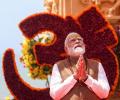
'At the first sign of real trouble, that money will move. There will be a run.'

The RBI working group's proposal to allow corporate houses to set up banks is a 'good-looking' step in a 'bad direction' and may lead to crony capitalism and eventual financial instability, former chief economist of World Bank Kaushik Basu said on Thursday. Basu further said that there is a good reason why all successful economies have a clear dividing line between industries and corporations on the one hand, and banks and lending organisations on the other.

The Reserve Bank of India (RBI) has extended the trading hours for the interbank call money market from July 1, and that of repo and tri-party repo markets from August 1. Market participants said the decision is intended to help reduce the large Standing Deposit Facility (SDF) balances held by banks with the RBI, thereby addressing liquidity mismatches.

Opening up the corner office is fine, but will the government be able to attract talent without giving a market-rate salary?, asks Tamal Bandyopadhyay.
Private sector bank board members have urged the Reserve Bank of India (RBI) top brass to consider workload management of the boards as they feel there are too many issues that go to the boards for approval and the situation becomes unmanageable at times. The views were conveyed to the regulator on Monday in a conference of directors of private sector bank boards on the theme "Transformative Governance Through Sound Boards". RBI governor Shaktikanta Das, deputy governors Swaminathan J and M Rajeshwar Rao, and other senior officials of the central bank participated in the conference.

An internal working group set up by the RBI has proposed to raise the cap on promoters' stake in private banks from the current 15 per cent to 26 per cent in 15 years. The group has also recommended that large corporate or industrial houses may be allowed as promoters of banks only after amendments to the Banking Regulation Act and strengthening of the supervisory mechanism for conglomerates, including consolidated supervision. The Reserve Bank of India had constituted the internal working group (IWG) on June 12, 2020, to review extant ownership guidelines and corporate structure for Indian private sector banks.
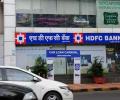
HDFC Bank on Sunday said that it will "pursue all lawful remedies" to recover public funds and address the retaliatory actions taken by the Mehta family of the Lilavati Kirtilal Mehta Medical (LKMM) Trust, which has filed a complaint against the bank's managing director (MD) & chief executive officer (CEO) Sashidhar Jagdishan alleging financial fraud.

NBFCs with a proven track record, supported by the brand values of reputed corporate, can play a key role in bringing the benefits of banking and economy to the underserved and newer segments of India.

By all available indications, the White House drafted a face-saving note and handed it, ready-made, to Islamabad. Pakistani Prime Minister Shehbaz Sharif was supposed to then post it in the guise of a plea urging Trump to extend the deadline by two weeks 'to allow diplomacy to run its course'. Trump would then graciously accept Pakistan's 'request' and declare a ceasefire. Sharif dutifully posted the message on X. Except that he, or whoever was handling the account, forgot to delete the tell-tale first line visible in the edit history: 'Draft - Pakistan's PM Message on X'. Prem Panicker's must read blog on the Iran War.

Taking Kharg would give the US control over virtually all of Iran's oil exports and thus provide significant leverage, notes Prem Panicker in his must read daily blog on the Gulf War. It would also put American troops within range of Iran's remaining missiles, drones, and artillery on a piece of real estate that is just eight square miles in size, and just 15 miles from the Iranian mainland.
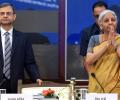
Sanjay Malhotra takes charge as the 26th RBI governor at a time when headline retail inflation has shot up to 6.2%.

Finance Minister Nirmala Sitharaman on Tuesday asked fintech firms to focus on risk management at a time when criminals are using AI to mimic voices, clone identities and create lifelike videos to manipulate people.
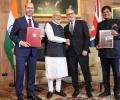
'That way you're not hostage just to US sort of exports to India.'

'Facilitating conversion of well-run NBFCs into banks is urgently needed.'

If indeed the gate opens for big industrial houses, the RBI needs to be smarter than them and demonstrate it through action, not reaction, observes Tamal Bandyopadhyay.

The Russians have termed Putin's visit to India, his first to this country since the outbreak of the Russia-Ukraine war, as 'Druzhba Dosti', which means 'friendship' in Russian and Hindi respectively.

Reserve Bank of India (RBI) deputy governor M Rajeshwar Rao on Wednesday defended the central bank's decision of not allowing industrial houses to float banks, and said more deliberations are needed before RBI changes its stance on this issue agreed back in 2001. An internal working group (IWG) of the RBI had recommended allowing industrial groups into banking, but late last month the RBI said it kept on hold the two recommendations of allowing industrial houses and large non-banks to float banks. However, RBI had accepted 21 of the 33 recommendations of the group that submitted its report a year ago.
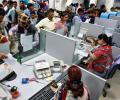
Ramalingam Kalirajan offers some easy steps to reactivate your accounts with banks like SBI, HDFC Bank, IDFC First Bank and PNB just so that you can start availing all the benefits linked to your account.

'The government is putting insurance in the same category as food, which is essential for life.' 'Now this is an opportunity for the sector to focus on the consumer.'

Group Captain Shubhanshu Shukla, India's second astronaut, shares his journey from a shy child hearing stories of Rakesh Sharma to becoming part of the Axiom-4 mission to the International Space Station. He emphasizes the role of the IAF in his transformation and inspires India's youth to explore space.
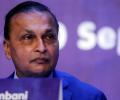
IndusInd International Holdings chairman Ashok Hinduja on Tuesday announced the acquisition of Reliance Capital, completing the three-year-long resolution process of the debt-ridden company. IndusInd International Holdings Ltd (IIHL) has transferred the bid amount to the escrow account of the lender, and the takeover of the management from the Administrator will happen on Wednesday.

The government is looking to give Bharat Global Ports a certain amount of domestic exposure after it set up the state-owned consortium to increase India's global maritime heft, officials aware of the development said. The intended domestic exposure is meant to give the consortium experience and build its credentials for international projects.
HDFC Bank has reshuffled the portfolios of its senior management team. This is the first major rejig after the amalgamation of HDFC Ltd on July 1. "The runway for our growth is large. This change is being done to bring in a very sharp focus on leveraging what we have built and for enhanced execution," said Sashidhar Jagdishan, managing director and chief executive of HDFC Bank, explaining the reason for this overhaul.

'Das is friendly, but he finally does what he does. The quality of engagement is very good.'

Insurance coverage for deposits in non-banking finance companies is unlikely to be provided as Reserve Bank of India has expressed reservations over the move.

For nearly two decades, Nitish Kumar has cultivated women as a distinct constituency. 'To create a broader vote base, he thought it would be better to bring women to electoral politics.'
